


1. Introduction to Our guide to Payroll in Uganda
2. Setting Up a Business
3. Employment Practices
4. Taxation & Social Security
5. Payroll Operations
6. Hiring & Termination
7. Compensation & Benefits
8. Visas & Work Permits
9. Location-Specific Considerations
1. Introduction to Our guide to Payroll in Uganda
Doing Business in Uganda
Investing in Uganda
Uganda provides foreign investors with a significant opportunity to invest in an expanding African economy. The government welcomes inward investment, with some restrictions upon entity structures.
Basic Facts about Uganda
Full Name: Republic of Uganda
Population: Approximately 49 million (2024 estimate)
Capital: Kampala
Primary Language: English (official), Swahili (official), and Luganda
Main Religion: Christianity
Monetary Unit: 1 Ugandan shilling = 100 cents
Main Exports: Gold, coffee, fish, cocoa and Tea
GNI per Capita: US $980 (2023)
Internet Domain: .ug
International Dialing Code: +256
How to say
Hello: hujambo
Good morning: Habari ya asubuhi
Good evening: Habari ya jioni
Do you speak English? Unajua Kiingereza?
Goodbye: kwaheri
Thank you: asante
See you later: Tutaonana baadaye
2. Setting Up a Business
Registrations and Establishing an Entity
In Uganda, all companies must be registered with local authorities in order to process payroll.
Banking
It is not mandatory to make payments to employees and authorities from an in-country bank account, however, the inter-country bank charges for electronic transfers can be quite high.
3. Employment Practices
Working Week
The working week in Uganda is Monday to Friday 0800 – 1700 hours and Saturdays 0800 – 1230 hours. Lunch breaks are between half an hour and one hour long.
Employment Law
Holiday Accrual
If the employee receives commissions or variable payments monthly, you have to calculate the average of the three months before holidays and based on this average you calculate the payment.
Maternity Leave
An employee is entitled to at least-84 days' paid maternity leave; or 100 days paid maternity leave if the employee gives birth to more than one child at the same time.
An employee may commence maternity leave at any time from 4 weeks before the expected date of confinement, or on an earlier date if a medical practitioner certifies that it is necessary.
No employee shall work within 6 weeks of the birth of her child, unless a medical practitioner certifies that she is fit to do so.
Subject to the provisions of subsections (2) and (3), the employee may resume employment on the same terms and conditions of employment at the end of her maternity leave. An employer is only obliged to grant paid leave for four terms of maternity leave to an employee.
Paternity Leave
An employee shall be entitled to at least three days paid paternity leave if the leave is taken within seven days of the birth of a child and the employee is the father of the child. The employee will be entitled to the three days paternity leave irrespective of how many of the employee’s children are born within the same leave cycle.
Sick Leave
An employee shall be entitled to sick leave for at least 126 days in any leave cycle.
The sick leave shall be calculated as follows-;
- The first 63 days shall be paid full wages;
- The second 63 days shall be paid half wages.
An employer shall not be required to pay an employee for sick leave if;
- The employee fails to produce a medical certificate; or
- The employee is entitled to paid sick leave under any law, fund or collective agreement
National Service
National service is not mandatory in Uganda.
4. Taxation & Social Security
Tax & Social Security
The tax year runs from 1st July to 30th June.
Apprenticeship & Training Tax
The due date for remitting PAYE is by the seventh of the following month.
A PAYE summary statement is due within 30 days after each six-month period.
|
Taxable Income (Per Month) |
Rate % |
Cumulative Tax Payable |
|
0 - 270,000 |
0 |
0 |
|
270,001 - 520,000 |
8 |
0 |
|
520,001- 760,000 |
20 |
20,000 |
|
760,001 – 1,000,000 |
25 |
68,000 |
|
1,000,001 + |
30 |
128,000 |
The penalty for late payment is the statutory rate of the year + 5% of the total outstanding amount.
Social Security
NSSF (National Social Security Fund) is deductible from employees (10% of gross) with the employer paying the same amount on the employee’s behalf. Submissions to the NSSF authority are to be made within one month after the month of deduction.
Skills Levy: Employer is to pay 3.5% of the gross on behalf of the employee (only for a company with more than five employees).
Workers Compensation: Employer is to pay 0.5% of the gross on behalf of the employee..
Reporting
|
Monthly |
|||
|
For each document please provide the following information: |
|||
|
Legal name/document number of each document |
PAYE return |
Skills Levy |
Pension schemes (NSSF, PPF, PSPF) |
|
What type of information is required to complete the form? |
List of employee PAYE deductions |
List of employees on whose behalf employer is contributing the levy. (i.e. 6 per cent of gross pay) |
List of employee NSSF deductions |
|
Where are the documents to be sent to and by what date should they be submitted? |
To the Uganda Revenue Authority within seven days of month-end. |
To the relevant scheme within one month after month of deduction. |
|
|
Can the documents be submitted by a payroll partner or does it have to be submitted by the employer? |
It is advisable to have the employer submit to avoid delays and to ensure a correct receipt is obtained to avoid future problems. |
It is advisable to have the employer submit to avoid delays and to ensure a correct receipt is obtained to avoid future problems. |
It is advisable to have the employer submit to avoid delays and to ensure a correct receipt is obtained to avoid future problems. |
|
Does the client need to sign the form |
Yes |
Yes |
Yes |
5. Payroll Operations
Payroll
It is legally acceptable in Uganda to provide employees with online payslips. The payslips must be secured with restricted access.
Reports
By law, payroll reports must be kept for seven years.
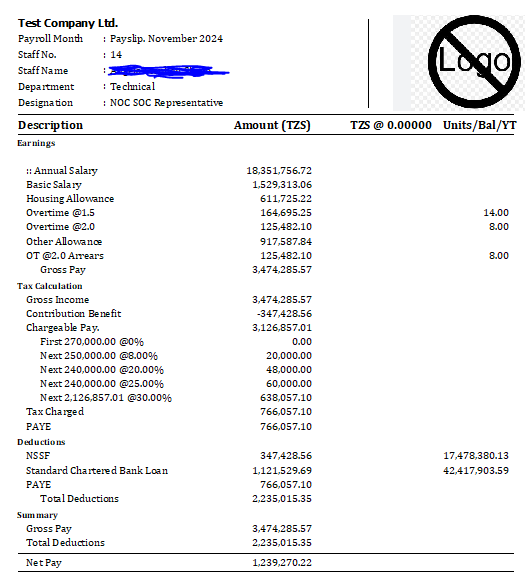
Pay-slip Example
6. Hiring & Termination
New Employees
When an employee first starts employment with a company, they must be registered with the TRA (Uganda Revenue Authority) and the pension scheme.
TRA will provide a TIN (Tax Identification Number) and the pension scheme will also provide a scheme number. All registrations must be made within the first month for the new start commencing work.
The only information that is required for setting up a new start is the employee’s personal data.
A new employee must be registered with the authorities within 80 days from the start date of employment, in which the company has to present its structure to the SII and await authorization to start operations.
Leavers
There are no legislative timescales for an employee’s final payment in Uganda. The payment timescale will depend on the terms of the employment contract.
7. Compensation & Benefits
Employee Benefits
Expenses
Any cash allowances pertaining to employee expenditure e.g. telephone; fuel, house, travel etc. will be added onto the basic salary and taxed accordingly.
Any non-cash benefits e.g. company house, company car etc. will be taxed at prescribed rates.
All allowances and benefits are provided at the employer’s discretion and are taxable.
8. Visas & Work Permits
Visas & Work Permits
In order to hire a foreign employee, the company must apply for a Class B permit for the employee. The application form for this is available from the Department of Immigration (Form TIF.1) at no cost and there is no processing fee.
The application form should be submitted with the following information:
- five photographs
- birth certificate
- curriculum vitae
- academic qualifications
- proof of experience
- organizational chart
- offer of employment
- proposed contract
The labor department will review the application and make a positive or negative recommendation to the Department of Immigration.
Class B permits have a fee of US $600 for two years. There is a renewal fee of US $300.